HyperIndex
Turn any contract into a real-time API: history backfilled, every new block followed and reorgs handled for you.
- head latency inside the indexer, from new block to stored row, excluding network time
- <10ms
From contract to API in three steps
Define the contracts and events to index, shape the data in TypeScript handlers, then deploy to Envio Cloud or your own infrastructure.
Say what to index
List your contracts, events and chains in config.yaml. envio init writes it for you from a contract address.
config.yaml name: erc20-indexer contracts: - name: ERC20 events: - event: "Transfer(address indexed from, address indexed to, uint256 value)" chains: - id: 1 # Ethereum start_block: 0 contracts: - name: ERC20 address: "0x1f9840a85d5aF5bf1D1762F925BDADdC4201F984"Shape the data and write handlers
Describe your entities in schema.graphql, then fill them from each event in a typed TypeScript handler.
src/handlers/ERC20.ts import { indexer } from "envio"; indexer.onEvent( { contract: "ERC20", event: "Transfer" }, async ({ event, context }) => { const { from, to, value } = event.params; const [sender, receiver] = await Promise.all([ context.Account.getOrCreate({ id: from, balance: 0n }), context.Account.getOrCreate({ id: to, balance: 0n }), ]); context.Account.set({ ...sender, balance: sender.balance - value }); context.Account.set({ ...receiver, balance: receiver.balance + value }); }, );Deploy anywhere
Push to your deployment branch and Envio Cloud builds and deploys it, or self-host it with Docker.
terminal $ git push origin main # a new deployment builds; the current one keeps serving
What HyperIndex replaces
The infrastructure a custom indexer needs you to write, test and maintain, built into HyperIndex.
| Custom indexer | HyperIndex |
|---|---|
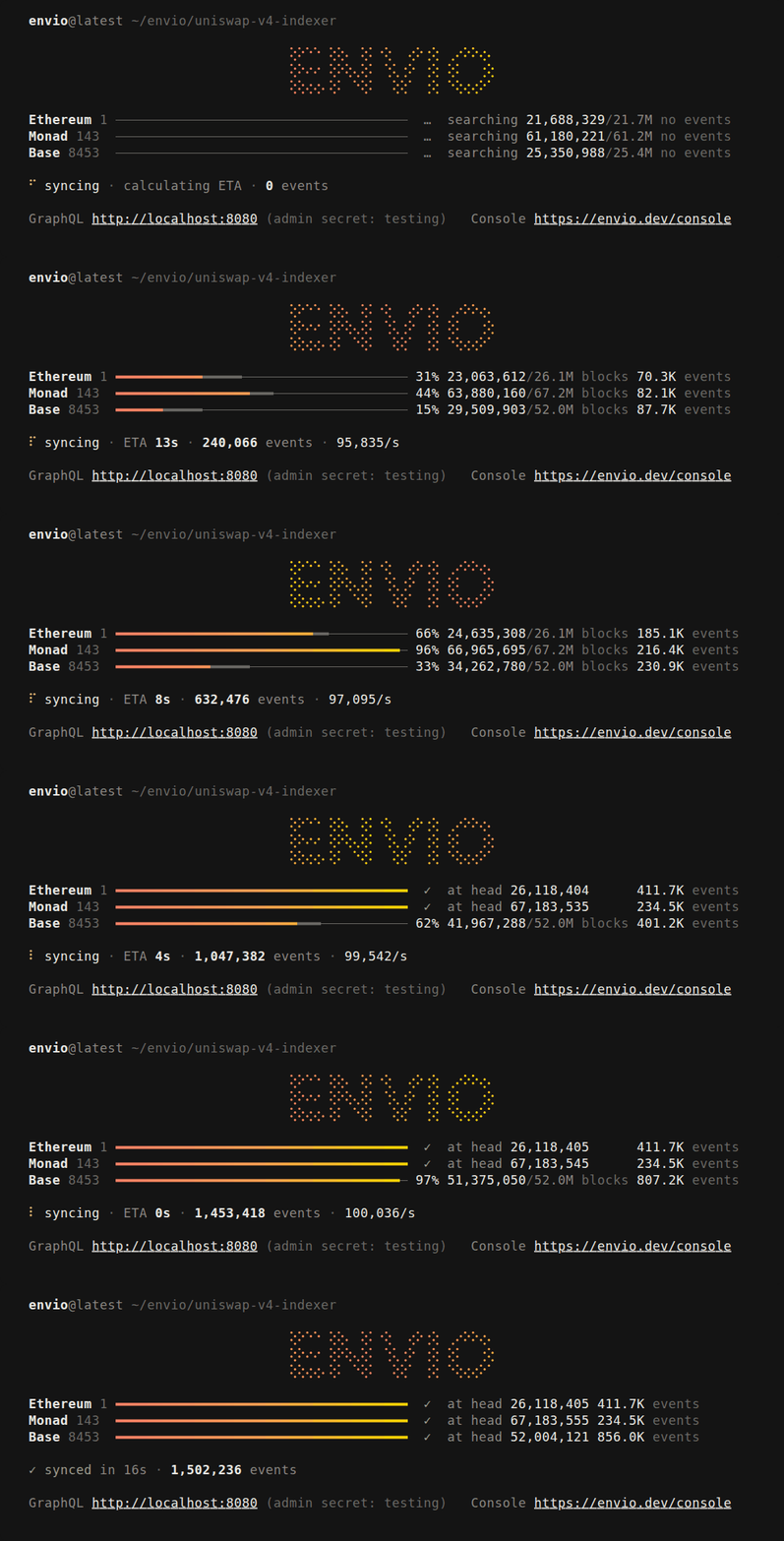
| RPC polling, block range by block range | Backfills at 100,000+ events/s |
| ABI decoding by hand | Typed handlers generated from your ABI |
| An API layer to build | GraphQL API generated from your schema |
| Reorg detection to write and test | Reorg rollback built in |
| Logging and metrics to wire up | Metrics, logging and observability built in |
| Crash recovery to build | Resumes from the last checkpoint |
| Per-chain indexers to wire together | Many chains in one indexer |
| A test harness to build yourself | Local dev environment and test framework |
No vendor lock-in
Everything you build on Envio stays yours to run, wherever you choose.
- Public code
Our licence lets you use and self-host it for your own projects. Reselling it as a hosted service isn't permitted.
- Any EVM chain, via RPC
HyperSync powers 81+ chains at full speed. On any other EVM chain, point your indexer at an RPC URL.
- Self-host anywhere
Run it on your own infrastructure with Docker, or let Envio Cloud run it for you.
Production capabilities, built in
Factory and wildcard indexing, off-chain integrations, streams and notifications, Postgres and ClickHouse storage, any EVM chain or Solana, with a test framework.
Factory contracts
Index contracts created at runtime, with billions of registered addresses supported.
Wildcard indexing
Index an event from every contract that emits it, such as every ERC-20 Transfer, with fine-tuned filters.
Off-chain integrations
Call external APIs and RPCs from handlers, with batching, caching and rate limits.
Streams and notifications
Send webhooks and notifications from your handlers as onchain events land.
Postgres and ClickHouse
GraphQL over Postgres for your app, and ClickHouse storage for analytics (Dedicated on Envio Cloud).
Any EVM chain
EVM chains over HyperSync, or over any RPC URL as a fully supported source, with RPC fallback for resilience.
Solana programs
Index instructions, inner instructions and account balance activity, decoded from an Anchor, Shank or Codama IDL.
Test framework
Mock events and database state, then check what your handlers do, without syncing a chain.
Built for AI coding
An agent-aware CLI, built-in skills and a docs MCP server, so coding agents build indexers the documented way.
Where HyperIndex fits
The solutions HyperIndex powers, from production APIs and event delivery to agent feeds, and the products it runs with.
- Blockchain APIs & analyticsYour own dataset from onchain data: a production GraphQL API for your app, or analytics in ClickHouse.
- Event streamingWebhooks and streams triggered by onchain changes, with decoded event data.
- AI agentsReliable onchain data for your AI agents, or agents that build production tools on Envio.
- Subgraph migrationMove your subgraphs off The Graph. Run them unchanged on the Subgraph Engine preview, have Envio migrate and host them, or port them to HyperIndex with AI.
HyperIndex in production
Teams serving production APIs from HyperIndex.
 synced a PancakeSwap V3 subgraph stuck for 2 years in 10 days
Revert Finance builds analytics and management tools for AMM liquidity providers. Its PancakeSwap V3 subgraph on The Graph had been stuck at 70% sync on BNB Smart Chain for over two years. A HyperIndex indexer synced all 1,711,569,200 events to 100% in 10 days, with HyperSync removing the RPC bottleneck.
HyperIndex FAQ
Building, testing and deploying indexers, the chains and languages it supports, and what HyperIndex costs.

What is HyperIndex?
HyperIndex is Envio's multichain blockchain indexer. You write event handlers in TypeScript, point it at your contracts, and it turns their historical and live events into a database behind a GraphQL API, on any EVM chain, Solana or Fuel.
HyperIndex overview →What's the difference between HyperIndex and HyperSync?
HyperIndex is the full indexing framework, with your schema, your handlers and a GraphQL API. HyperSync is the data engine that powers its backfills, and you can also query it directly for raw logs, transactions and traces in your own pipelines.
HyperIndex vs HyperSync →How is HyperIndex different from a subgraph?
HyperIndex indexes from HyperSync instead of RPC, 6–879x faster than other indexers in the open benchmark, The Graph included. It also indexes many chains from one indexer and uses TypeScript handlers instead of AssemblyScript.
Envio vs The Graph →Which chains does HyperIndex support?
Any EVM chain, Solana and Fuel. 81+ chains have HyperSync for the fastest backfills, and on any other EVM chain you point your indexer at an RPC URL.
Supported chains →Is HyperIndex free to use?
HyperIndex is free to build with. On Envio Cloud the development plan is free, production plans start at $70 a month, and Dedicated plans are priced to your workload.
Hosting pricing →Build your first API on HyperIndex
Start on the free development plan and turn your first contract into an API.